Oven problems · 04 of 18
Convection Fan Grinding or Ticking
Short answer
A grind or tick that begins and ends with convection usually comes from the fan assembly in the back wall: a motor bearing wearing out, the blade catching its cover, or the cover itself working loose. Stop using convection until it has been looked at, because a rubbing blade only gets worse. Summit Cooking Appliance Service, (425) 272-6613, can tell a fan fault from a loose oven or a stray rack.
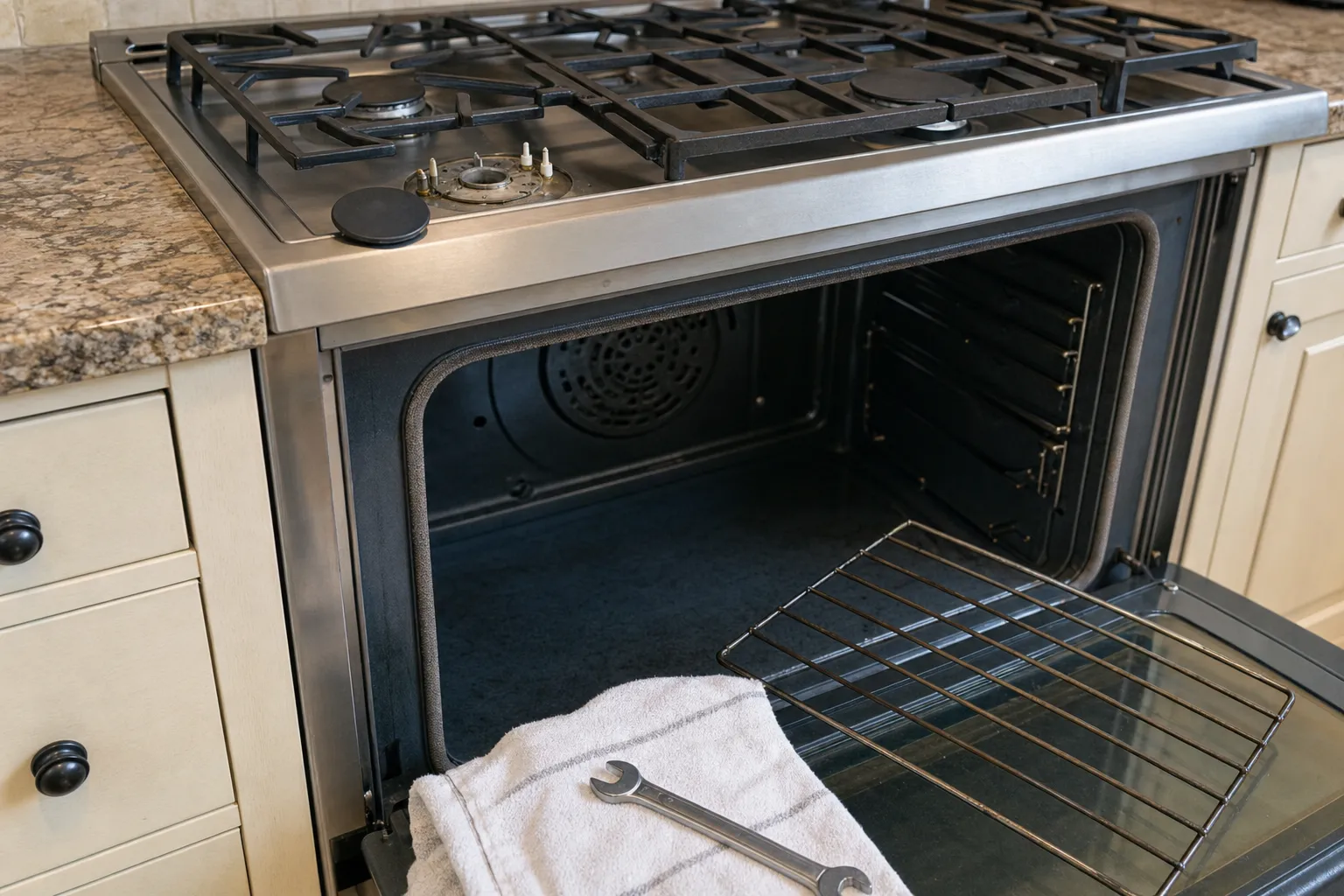
Oven fault, Issaquah or along I-90
Summit Cooking Appliance Service
One visit reads the appliance and the installation around it. The $89 call-out pays for that reading and is deducted once you sign off the repair. Visits run 8:00 am – 8:00 pm, seven days; phones picked up 24/7.
Three sounds, one fault
A Wolf oven makes three kinds of noise, and only one of them points at a repair. Pops and bangs from a new oven as it warms up or cools down are the cavity expanding and contracting; Wolf asks to hear about them only if they persist. A steady hum long after the oven is off is the cooling fan, which Wolf says cannot be switched off and may keep going for hours while the cavity cools. A grind, scrape or rhythmic tick that starts when convection starts, and stops when it stops, is the convection fan.
What wears out
The fan spins behind a cover at the back of the cavity. A tired motor bearing starts as a faint growl and ends as a grind. A blade knocked slightly out of true clips the cover once a turn, which is the ticking. A cover that has worked loose rattles once the fan is up to speed. All three are ours to open up; none is a job for a screwdriver through the oven door.
Before you book
- Take every rack and pan out and run Convection empty. If the noise has gone, something was touching the fan cover; refit each rack fully onto its guides.
- On a Wolf gas range the convection fan runs only with the door shut. Open the door while it is running: if the noise stops at the same moment, it is the fan.
- Sort the sounds. Pops or bangs while a new cavity heats or cools are the metal settling, which Wolf calls normal; a fan heard long after cooking is the cooling fan, which Wolf says keeps running by design.
- Stop there. Whatever sits behind the appliance's own panels, on its gas valves or live inside it is ours to test: call Summit Cooking Appliance Service on (425) 272-6613 and say what you found in the steps above.
Questions
Can I carry on baking while the convection fan is noisy?
On a Wolf gas range the fan runs only when you press its button, so ordinary Bake without it is fine. On an electric Wolf oven, listen in the mode you want: if the noise is there, leave that mode alone. Summit Cooking Appliance Service, (425) 272-6613, will tell you which of your modes use the fan.
Signed
Imogen Fairhurst
Bench specialtyovens and calibration