Cooktop Repair
Wolf Burner Clicks But Will Not Light: Working Through It
A burner that sparks but never catches is not a dead igniter — the spark proves that. Summit Cooking Appliance Service, (425) 272-6613.
Written by
Rafael Monteiro
Bench specialtyventilation and blowers
Part of Range problems, the symptom series this guide sits in.
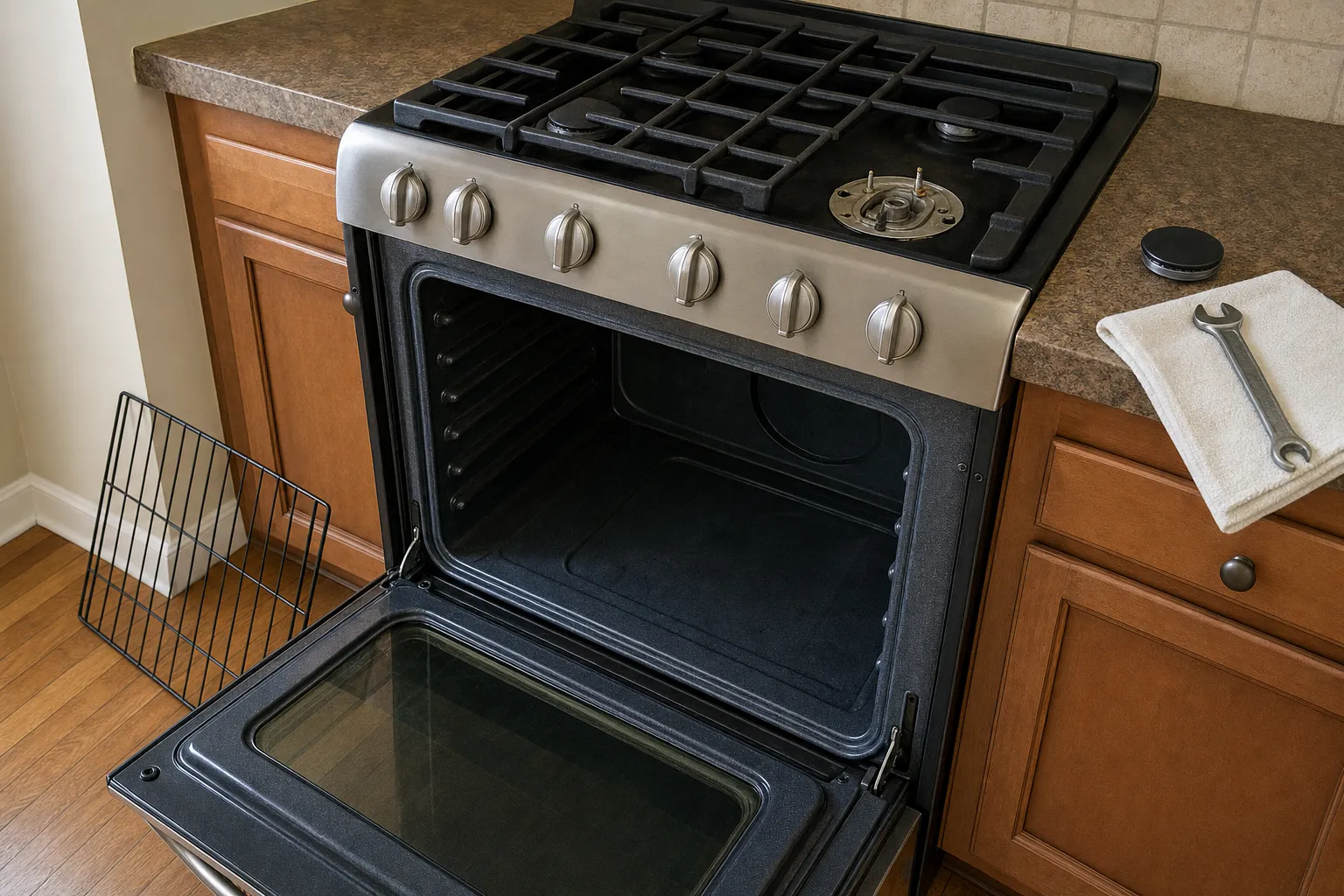
Few faults bring us out to Issaquah kitchens as often as a burner that ticks away and refuses to catch — and few are got wrong as reliably. The instinct is to say the igniter has failed. But the clicking is the igniter — if you can hear it, the ignition circuit is producing a spark and the fault is almost certainly somewhere else.
That is good news, because most of what it turns out to be is either free to fix or a small part.
Start with the burner cap and head
Far and away the most frequent cause, and the one you can settle in two minutes.
A sealed burner is a stack: the head sits on the base, the cap sits on the head, and the whole assembly only works when everything is seated in exactly its designed position. Lift a cap a couple of millimetres out of alignment — easily done after cleaning, or by nudging a heavy pan across the hob — and the gas no longer arrives where the spark is. You get a healthy spark, gas escaping in the wrong direction, and nothing catching.
With the cooktop cold and every knob off:
- Lift the cap and check the underside. It should sit flat and square on the head with no rocking.
- Look at the head itself. Most have a locating notch or pin that lines up with the base; if it can be dropped on in more than one orientation, it can be dropped on wrong.
- Check the ports — the slots around the rim. A cap that has been through a boil-over will have some of them glazed shut with sugar or fat.
- Make sure everything is bone dry. Water in the burner head after a clean is a classic cause of a burner that “stopped working for no reason”.
Refit, and try again. A good proportion of these calls end here.
Read the pattern of the clicking
If it still will not light, the pattern tells you a lot.
One burner clicks, others light normally. The problem is local to that burner: the cap, the head, the ports, or the electrode serving it. Look closely at the electrode — the small ceramic-sleeved pin beside the head. A hairline crack in that ceramic lets the spark arc to the nearest metal instead of jumping the gap it is supposed to, and the arc is often visible in a dark kitchen. The spark then appears perfectly healthy while doing nothing useful.
Every burner clicks continuously, including with all knobs off. That is the spark module being triggered when it should not be — the case clicking with every knob off has its own page. The usual cause is moisture or residue in a switch behind a knob — again, very often after a spill or an enthusiastic clean. It sometimes clears on its own once the assembly dries out over a day or two. If it does not, the switch or the module needs attention, and that is not a homeowner job because it means going in behind the control panel.
Clicking continues after the flame is lit. On most designs the module should stop once the flame is established. Continued clicking suggests the flame is not being sensed properly, or the module is not receiving the signal to stop.
Spark is weak, thin or intermittent. Usually the module itself, sometimes its supply. Worth noting whether it is worse when the kitchen is humid.
Check that gas is actually arriving
Easy to overlook when only one appliance is misbehaving, but worth ten seconds.
If every burner on the cooktop is affected at once, and especially if an oven on the same supply is also struggling, look upstream rather than at the appliance. Has the supply been worked on recently? Has a shut-off valve been knocked partly closed behind the range? Did anything change after a kitchen refit?
A related situation that comes up in newer Issaquah Highlands builds: a house tight enough that a powerful hood on high can pull the kitchen into slight negative pressure. That will not usually stop a burner lighting outright, but it can make ignition unreliable and flames unstable. If the burner behaves when the hood is off and misbehaves when it is on full, that is the trail to follow, and it is a ventilation and make-up air question rather than a cooktop fault.
Finally, if the burner lights readily with a match but not with the spark, you have proved gas delivery is fine and isolated the fault firmly to the ignition circuit. That is a genuinely useful test — just do it once, deliberately, and never with the knob left on while you go and hunt for matches.
Where to stop and call
Stop and call us if you can smell gas at any point. Leave the property, call your gas utility or 911 from outside, and do not switch anything on or off on the way out. That is an emergency, not a repair booking.
Short of that, stop when the fix requires going behind the control panel. That means the spark module, the switches behind the knobs, the wiring harness, or anything involving the gas valves themselves. Electrode replacement and valve adjustment sit on the same side of the line — they are straightforward jobs with the right parts, but they involve live gas components and a flame quality check afterwards that needs doing properly.
What you should absolutely do before ringing is gather the detail. Model and serial from the rating plate, which burner or burners are affected, whether the clicking is constant or only on demand, and anything that changed just before it started — a clean, a spill, a power cut, a conversion between natural gas and propane. Conversions in particular are worth flagging: a burner set up for the wrong gas will light badly, burn yellow and never simmer properly, and no amount of cleaning will change that.
Give us those four things on the phone and the right electrode, cap or module usually travels with the engineer on the first visit.
Follow-up questions
Every burner clicks when I only turn one knob. Is that normal?
On many gas cooktops it is: the electrodes are wired to spark together, while gas reaches only the burner whose knob you turned. Your model's use and care guide describes how its own ignition behaves. It stops being normal when the ticking goes on after the flame has caught, or starts by itself with every knob off.
Can I clean the burner ports myself?
Yes, and it is one of the most useful checks there is. Lift the cap and head off when the cooktop is cold, clear the slots with a straightened paperclip or a stiff brush, and let everything dry fully before refitting. Do not use a drill bit or anything that could enlarge a port.
The burner lights with a match but not with the spark. What does that mean?
Gas is arriving and the burner is fine, so the fault is in the ignition circuit — usually a cracked electrode, a wet or displaced one, or a spark module that is firing too weakly. It is a repairable fault and not a reason to replace the cooktop.